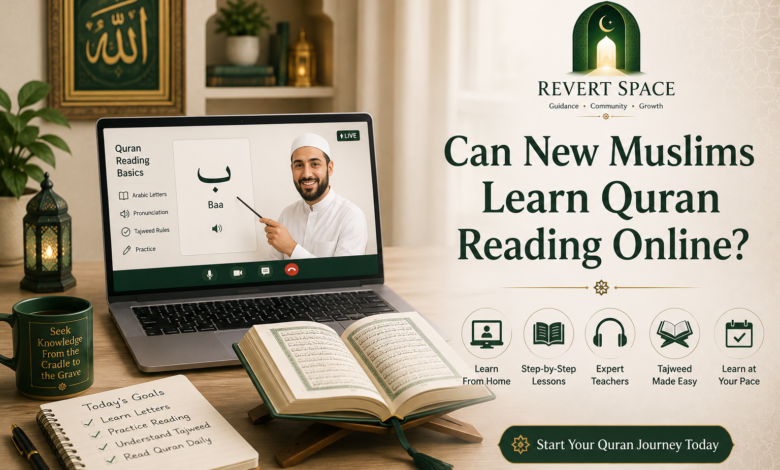
Reading Arabic script for the first time feels nothing like learning any other language most people have tried. The letters connect differently depending on position, vowels are marked with small symbols easy to miss, and pronunciation carries real religious weight rather than just being a matter of accent. Given all that, new Muslims learning to read Quran online often wonder whether a screen can actually replace sitting beside a teacher in person, and the honest answer is yes, with the right setup.
Why the Question Comes Up So Often
Quran reading isn’t like general Islamic knowledge, where a video lecture can transfer most of what’s needed. Correct pronunciation, called tajweed, depends on subtle mouth and throat positions that are hard to self correct without feedback. That’s exactly why so many new Muslims hesitate before starting online, assuming it must be inferior to an in person teacher. In practice, live video sessions solve most of that concern, since a teacher can hear pronunciation in real time just as clearly as they would sitting in the same room. The hesitation usually fades within the first few sessions, once a student realizes a teacher can correct a mistake the moment it happens, not after reviewing a recording days later.
How Online Quran Reading Actually Works
Most programs start with the Arabic alphabet itself, recognizing letter shapes in their isolated, beginning, middle, and final forms before ever attempting a full word. From there, students typically move into Noorani Qaida, a foundational reading primer used for centuries to teach pronunciation rules before tackling actual Quranic text. A live teacher listens through video call, corrects mistakes immediately, and repeats a letter or word until it’s said correctly, which mirrors in person instruction far more closely than most people expect. Most beginner programs run this sequence over several months, moving from individual letters to short words, then to the actual verses, rather than skipping ahead once basic reading feels comfortable.
What Makes Live Correction Possible Online
The concern most new Muslims raise is whether a teacher can actually hear pronunciation errors through a screen. Modern video calling handles this better than most assume. A teacher can catch a mispronounced letter, an incorrect elongation, or a skipped rule of tajweed just as reliably online as they could in a classroom, because the correction happens by ear, not by watching mouth movements up close. Recording sessions for later review adds another layer of feedback that in person classes rarely offer, letting a student replay a corrected pronunciation multiple times until it fully sinks in, rather than relying purely on memory of what was said in the moment.
One on One Sessions Versus Group Classes
New Muslims learning to read Quran benefit from a different pace than someone raised reciting since childhood. One on one online sessions let a teacher slow down on exactly the letters or rules a specific student struggles with, without holding back a group of more advanced classmates. Group classes still have value for community and cost, but for the specific skill of learning to read accurately from scratch, individual attention tends to move faster and catch mistakes sooner. Many programs offer a hybrid path, starting one on one to build core pronunciation, then moving into a small group once the fundamentals are solid enough to keep pace with others.
Setting Realistic Expectations for Progress
Learning to read Quran fluently takes months of consistent practice, not weeks, regardless of whether the setup is online or in person. New Muslims sometimes expect faster results simply because online classes feel more convenient, but convenience affects consistency, not the actual pace of skill building. Two or three short sessions a week, paired with daily personal practice, tends to produce steadier progress than infrequent long sessions squeezed in when time allows. It also helps to track progress loosely rather than by a strict deadline, since pronunciation skill tends to click gradually rather than arriving all at once.
Tools That Support Online Learning
Beyond live sessions, several tools make online Quran reading more effective. Recording your own recitation and comparing it to a teacher’s correction helps reinforce lessons between classes. Many platforms also offer color coded tajweed texts, where different rules are marked by color, making it easier to internalize patterns visually alongside the audio correction a teacher provides. A simple daily reading tracker, even a basic notebook, also helps students notice their own progress over weeks rather than judging themselves against a single difficult session.
Having watched many new Muslims go through this exact learning curve, one thing becomes clear quickly: the students who progress fastest aren’t necessarily the ones with the best teacher, but the ones who practice daily between sessions rather than only during class time itself.
Did You Know?
Noorani Qaida, still used by online and in person teachers alike, was developed specifically to simplify Quranic pronunciation rules for beginners, and its structured approach has remained largely unchanged for generations precisely because it works.
Pro Tips for Learning Quran Reading Online
- Practice for ten minutes daily between sessions rather than relying on class time alone
- Ask your teacher to record corrections so you can review them later
- Use a stable internet connection and a quiet space to avoid missed pronunciation feedback
A Common Mistake to Avoid
Rushing past the alphabet and Noorani Qaida stage to start reciting actual Quranic verses too early often builds bad pronunciation habits that are harder to correct later. Slowing down at the foundational stage, even if it feels tedious, saves far more time in the long run.
Learning to read Quran online isn’t a lesser version of in person instruction, it’s simply a different delivery method for the same careful, letter by letter process. With a qualified teacher, consistent short sessions, and daily practice in between, new Muslims can build genuine reading fluency from home, one correctly pronounced letter at a time. The screen is just the medium. The actual learning, patient repetition, corrected mistakes, and steady progress, looks the same whether it happens in a living room or a mosque classroom.
Frequently Asked Questions (FAQs)
Can a teacher really correct my Quran pronunciation over video call?
Yes. Pronunciation correction happens by ear, not by watching mouth movements closely, so a teacher can hear and correct mistakes just as effectively online as in person.
How long does it take to learn to read Quran online as a beginner?
Most students spend several months moving from the Arabic alphabet through Noorani Qaida before reading actual verses, with fluency continuing to build well beyond that point.
Do I need to know Arabic before starting online Quran reading classes?
No. Programs typically start from the alphabet itself, assuming no prior knowledge of Arabic script or pronunciation rules.
Are one on one online Quran classes better than group classes for beginners?
For pure reading accuracy, one on one sessions tend to progress faster since the pace matches the individual student rather than a group average.
What is Noorani Qaida and why does it matter for beginners?
It’s a foundational primer used to teach pronunciation rules before Quranic text itself, and most structured programs, online or in person, begin here.
Can I learn Quran reading online without live video sessions?
Live correction significantly speeds up accurate pronunciation. Recorded lessons alone make it harder to catch and fix mistakes in real time.
What tools help reinforce online Quran reading lessons between classes?
Recording your own recitation, color coded tajweed texts, and a simple daily practice tracker all help reinforce what’s covered during live sessions.
Conclusion
Yes, new Muslims can absolutely learn Quran reading online when they have a qualified teacher, a structured learning plan, and consistent practice. Online classes can provide real-time pronunciation correction, flexible scheduling, and personalized guidance, making them a practical option for beginners who are starting from the Arabic alphabet.
The key is not how quickly you finish, but how consistently you practice and build correct pronunciation from the beginning. Starting with the Arabic alphabet and Noorani Qaida, practicing a little every day, and learning from a teacher who can correct mistakes can create a strong foundation for confident Quran reading.
For new Muslims who want step-by-step guidance, Revert Space offers resources designed to make learning Quran reading more accessible and manageable. With patience, regular practice, and the right support, learning to read the Quran online can become a rewarding part of your Islamic journey.